
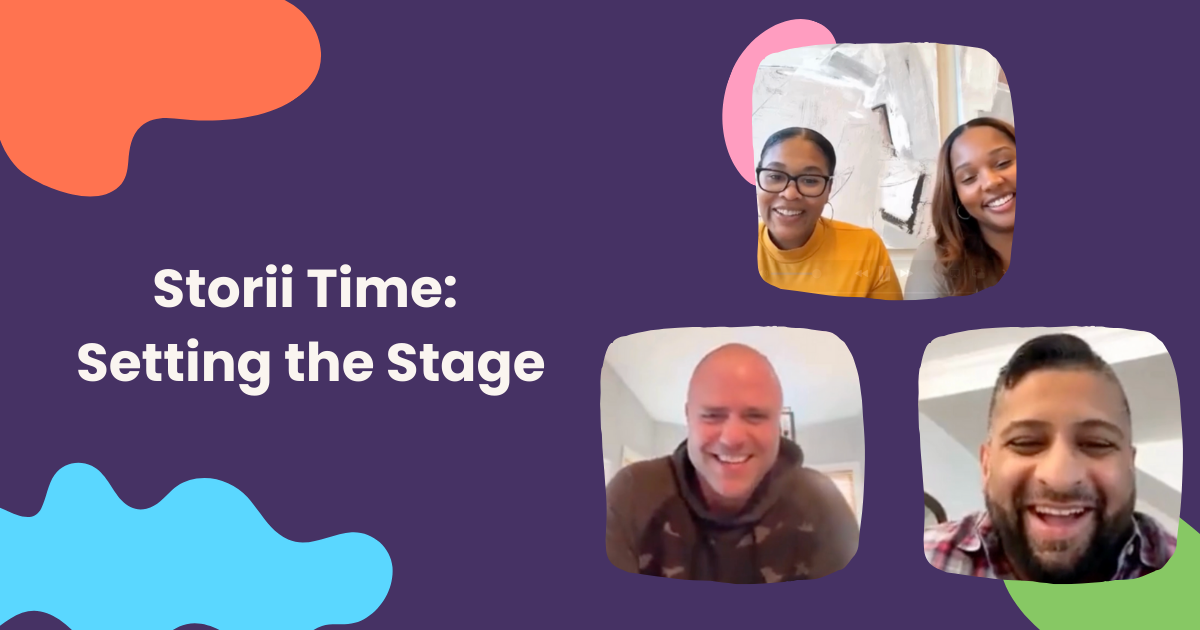
Selling a home is selling a lifestyle. This week, SHE Designs joins Storii Time to walk through how they help home buyers visualize their future space through staging. 🛋️ ✨
Saad: How’s everyone doing?
Shana: Hey.
Cerese: Hey, Saad.
Saad: Good to see you. I see half of each of your faces.
Cerese: Oh, really? Yeah. Okay. How about now?
Saad: That’s good.
Mike: That’s good. Your family.
Shana: Yeah, it’s nice. Yeah. We actually like each other. So..
Saad:Love it. Love it. Where are you guys calling in from?
Shana: We’re at my house. So, yeah. We’re in Boston.
Mike: Yes. Right on. Nice. Nice artworks.
Shana: Yeah. Thank you.
Mike: That’s what we’re going to ask. That’s probably what I saw him ask. It’s beautiful.
Shana a nice backdrop. Yeah, I was like, this a warehouse? And you’re using one of the paintings that you use.
Cerese: That would have been a good place to go live.
Saad: I’m just saying. time. Next time.
Cerese: Yeah. Right. I like it.
Shana: How you guys doing?
Saad: Good. We’re good. Can’t complain. Busy. This time of year, things seemingly are supposed to slow down. They really haven’t…. oh It’s a good thing right so good to be busy but excited for at least a little bit of a lull just to spend some time with family and all that kind of stuff.
Saad: Well, thanks for jumping on today guys, I know it’s been it seems like it’s been a long time coming
Mike: It actually turned out alright. The Roslindale condo you guys did finally closes tomorrow. were subject to the government shutdown delaying loans and stuff. It’s going to be a hell of a day.
Cerese: Well, congratulations. I’m happy that pulled through.
Mike: Thank you. Thank you. No, it looks so different without your stuff in there.
Saad: Most places do, right? I mean, I think that’s one of the reasons why we wanted to have you guys on was to kindof talk through some of that.
Saad: Like, naturally, we know as real estate agents and you guys naturally are familiar because that’s why you’re in the business…you know it makes a difference, right? But talk us through, I think it’d be helpful, well, first off, we’ve got the ladies from SheDesigns here on the live with us today to talk about staging.
Saad: Staging, as some of you may know, is a key part of the selling process. Something we always recommend to our clients, I think a lot of agents do when they’re working with a seller is like, and the property is vacant…staging makes a big difference. It shows people, in my view, the biggest thing is, two big things for me is number one, it allows people to see how a place can be utilized, how an area can be utilized. That’s number one. But number two, it also shows that the seller cares, right?
Saad: I think a lot of sellers don’t and they don’t stage it. It hasn’t been kind of clean, taken care of, and buyers can typically tell. That, at the end of the day impacts the quality of the offers and things like that. But talk us through your guys’ philosophy and strategy around staging a home after you’ve seen it the first time.
Shana: I think it’s very similar to kind of what you already spoke on. So definitely you want to realize and understand that first impressions are everything, right? And so you kind of only have that one shot to make a grand impression and you want to do it right. So, our philosophy is “do it right the first time” That’s the first thing. But you do it right the first time. And what we do is we make sure that we’re maximizing the space and we’re showing how to utilize the space. I don’t want to say hiding defects, but we’re kind of distracting buyers from things that you might not want them to see. And there’s a lot of that that happens that people don’t realize. So I think placement of furniture is everything.
Shana: What we’ll do is our initial walkthrough. Usually the properties are vacant. Sometimes the properties will have you know, clients furniture in there and we do occupy staging as well just to let you know, but vacants are a little easier. So we get a feel for the space, visualize a layout. and…
Mike: Real quick. Could we get your like closer…in the. I’m speaking with my hands too, but I’m all free.
Shana: So, visualizing a layout and really trying to figure out what story we want to tell because at the end of the day, we’re selling the lifestyle at the same time. Right. So you want the buyers to come in and be able to visualize how they would live in that space. And I think that’s what we’ve been able to master is getting the space to look and feel warm, cozy, and making someone wanna say, “wow, I wanna live here.”
Mike: Yeah. I think generally people just have a lack of imagination to see that stuff. We’re like, you guys can go in and see it yourself, but most people don’t have that innate ability to do so, so it does just like, they’re like, here it is, exactly. You can literally copy this exact layout if you’d like to.
Cerese: Yeah. So I was going to say, it can be difficult, you know, we do want to, we try to tailor to the style of the home. Some homes are more modern than others. And so when we talk about like hiding, it’s not that we want to hide things from the buyers. It’s just that we don’t want them to focus on like minor fixes because some things can just feel a little more…I think ideally people, a lot of people want turnkey. Not that we don’t stage turnkey homes, because sometimes with turnkey homes, know, people start to worry about the price. They’re like, I don’t know if it’s, know, but then older homes, they kind of just look at it as an old home.
Cerese: They don’t really appreciate what features it might come with. Older homes sometimes come with larger spaces. They might not come with amenities, but they might have like beautiful bay windows or a really unique layout that you can’t find anymore. So it’s very important for us to just sort of showcase that when we’re taking on the project.
Mike: Totally. I’m always curious as to like, Cerese and Shana, like who is like the, like what are your different roles or like who’s artistically visualizing stuff? And also like where are you keeping all this stuff and how you’re able to get out? Like I don’t, that basic logistic, I’m still in the dark on.
Shana: So when it comes to our roles, I think they’re interchangeable. I think we both have different strengths that we kind of know. I’m trying to think of one off the top of my head…
Cerese: Like when it comes to design and stuff, you like hanging pictures. And maybe I just don’t like it. just try to like, you’re so good at that, Shana. You know, she is good at hanging pictures because she didn’t want to have to ask anybody to do it.
Shana: And I think for her, if we’re going down that path, she likes to fluff pillows and she’s better at making the beds that I am. So, it works out, right? So when we’re in projects, we’re in the middle of projects, I think we both kind of just retreat to what we can do [technical difficulties]
Cerese: This is Shana’s thing, if there’s like a shelf, I know she loves doing shelves. I’m like, I’m not even gonna get in her way. Already have it planned out.
Shana: Coffee table styling, she’d rather be hands–off on…some clothes. It’s just little things like that. When it comes to doing walkthroughs, customer communication or client communication, we both just go for it hands-on. And if there’s something we both…live in Boston, but she lives more north, live more south. So if there’s a project that’s closer to her and she needs to, we need to go there for some reason, she’s going to go. If there’s a project closer to me, I’m going to go.
Mike: I think that’s good to have.
Shana: Yeah. When we do that, it’s, kind of figure out who’s going to spearhead the different projects.
Cerese: it’s just like my wife right here.
Saad: Mike and I can speak to that a little bit. Yeah.
Mike: Yeah. My husband.
Saad: I think a partnership, and especially when you know what your partner is good at, it can not only save a lot of time, but save a lot of headache. Some stuff can be unspoken, even though as a business you should still talk about it. It can be unspoken and get done in timely and efficient manner. That’s awesome that you guys have that partnership.
Saad: a question I have is when working with clients, so usually I’m guessing, you, do you communicate directly with clients typically or do you communicate with the agents? Is it a mix?
Mike: Good question.
Shana: It’s definitely a mix. Usually we’ll start talking with the realtor or the agent and if the seller is very involved then they become one of the point of contacts. So it really just depends on the project and how involved the seller needs to be.
Shana: But I think, I want to say we deal more with agents than sellers.
Cerese: Yeah. And sometimes it’s easier because the sellers can be a bit like taken aback by staging because they’re already so overwhelmed. Some sellers, they know what it is, but it’s just a lot for them to take on. So sometimes it’s easier to go through the agent so that they don’t feel like they’re just like, you know, have to worry about a million things when it comes to the sale.
Saad: Yeah, yeah. Is there like, whether working with agents or with the clients directly, is there like certain pushback? I mean, aside from price, obviously, is there a discussion that we have with sellers, right? Is like, is there ROI? Do I need to do this? Like all that kind of stuff, right? Like the common thing. But aside from that, Is there anything else, any other pushback that you guys normally get when it comes to working with Sellers and the whole concept of staging?
Cerese: I think only one time it was just we were working on a big, more expensive project in Beacon Hill and we have to go in and out of the property. We get keys to the lock boxes. So for them, there was architects involved and they’re like, do you know them to give us the keys and have them access the property and how well. So that was one. And then once they saw how we worked, they were like, oh, hey, yeah, leave the lights on. We’re going to head out if y’all can lock up. So, I think one thing is just building the trust because you might have some strangers coming in and out. You might be concerned about if they have a level of care with your property, it’s still their property and their baby at the end of the day…
Saad: Yeah, I mean, we had that experience in Somerville, right, with the neighbor downstairs. Yeah, I think it was, was one of you who called that neighbor the HOA final boss.
Cerese: Yeah.He was the HOA final boss.
Saad: I was hysterical. The best. The best.
Shana: So sometimes neighbors can be a factor, but usually it’s all smooth.
Saad: Yeah, I think with anything, communication is important. even if you communicate well, which I promise you I did. Even if you communicate well–tell your clients to inform the neighbors and things like that. Sometimes it’s things that you just can’t control. There are variables, just like in deals that we work with. Throughout the course of a transaction, we control as much as we can, but things will come up
Cerese: and CYA, cover your ass. Remember, he said knock the plants over, left them in this way. They were neatly stacked up. We came back and we were like, what plants were knocked over? They were neatly stacked on it, you know, but that’s why you have to take pictures and, you know, show like, hey, you know, this is how we left it. This is how we came in. You know, justkeep, like you said, communication. Keep everybody well informed so you’re not…
Saad: And is that one of the reasons it’s a little bit easier to work with agents is that they can be kind of like the… They can be the ones to communicate things properly and they have a relationship with the client.
Shana: Agents, they do this for a living, right? So they deal with this all the time. Sellers, this is like a one-time thing or it could be back at home, but this is not what they’re used to. So it’s a different world for them. Whereas agents, you know, they deal with stagers, they deal with different types of people as they’re going through the process. I think that’s another reason why…
Cerese: you can also to you don’t know like what the client is going through, know, you could be staging for somebody that’s selling the house because they’re going through a divorce. You know what I mean? Or, you know, so there’s some they’re already dealing with emotional factors, you know, I mean, we even had one situation where it was the neighbor who was trying to sell his house at the same time we were staging on one floor. And he was trying to sell his house because he was going through a divorce on the other floor. And it was tough for him because we’re over here staging and he’s trying to sell his house. So it’s already competitive for him. So, you know, and again, he was a little snippy, but we had to be compassionate toward like, it’s not personal. You know, we understand that this is hard for you, too. So we really just try to be compassionate and just try to be fair in the way that we work and just accommodate. You know, no stress on the realtor too. want to make it easy for the realtor. We don’t want them coming back to y’all…
Shana: Absolutely. And I think we skipped over…
Saad: the other unit too? Huh? Did you end up staging the other unit too?
Shana & Cerese: No. No But you know, the realtor was good. He delayed the sale and let him… You know what I mean? So again, you could always work with people and…
Shana: Yeah. No, I think we didn’t answer the second half of the question about where we store the furniture.
Mike: Oh, yeah. Right. want to know, like, how are you acquiring pieces? Where are they going? That’s sort of thing.
Shana: Yeah. So it’s been a journey. I’ll say that. We started off in storage units and rented storage units. And that got pricey because people who rent storage units know that they change the price of storage units all the time.
Cerese: Right and we were growing, so they were increasing the storage unit. And we were going to need a sign and then two.
Shana: So, we had to make a decision. It was around last year. We made a decision that it was probably best if we found some type of warehouse space instead of getting another storage unit, because I think at the time we were at three storage units. And now we’re in a warehouse space where we house all our furniture. It’s much better that way because with the storage units, had one on one floor…because you can’t control what’s available when you need it…So we were kind of all over the place. But now everything is in one place. It’s set up like a shop. We have all our accessories in one place, all the big furniture in another place, and everything else in between.
Shana: So that’s where we’re at now with storing in the furniture. And then as far as acquiring pieces, it’s a little bit of everything. So, you know, we order off of Wayfair, Amazon, we’re in HomeGoods, HomeSense all the time, Facebook Marketplace sometimes, you know, we’re there.
Cerese: We had to invest a lot like of our own money to sort of, you know, give ourselves a good like buffer. And then, you know, after that, you just we had to get to the point where we’re able to trade out furniture, like, you know, you take something from one property and then you can repurpose it in the next, but you have, you know, enough to where, you know, if we stage for you, we don’t want it to look identical to, say if you’re a coworker, you know, if you pass a song, we’re not going to give them the same set. We built ourselves up to have like a mix-and-match system. Yeah. And we could at least stage like, would you say like 12 houses right now?
Saad: you could do 12 listings at the same time.
Shana: Yes.
Saad: Oh, wow.
Cerese: Right now, probably.
Saad: So yeah, you definitely need a warehouse base.
Shana: Yeah, yeah, yeah. I mean, the goal is never to house everything at the same time, right? We always want to have the friends to help make it…So I mean, we haven’t had that problem yet. And hopefully we don’t have that problem. I don’t want that problem. But, we foresee, like you said in the beginning of this, the winter months, things slow down a little bit, but we don’t want it to slow down too much. And so far it hasn’t. So far, everything is still moving. Yeah, if we have to house everything all at once, that’s gonna be scary moment.
Saad: How often do sellers or even agents have preferences on like what pieces are used and like the color palette and like, know, all that kind of stuff. Basically how often are they stepping on your toes?
Shana: So, not often, but we do have some clients who don’t like the color black.
Cerese: And that’s OK.
Shana: Those are easy accommodations. They like the minimalist look. They’ll say…
Saad: so, more like preferences…. Than this is how this is exactly.
Cerese: Right. We have had that sometimes with the sellers. The agent will be like, I’m sorry. I know this is…. the realtors have been really good, but like I said, some of them do have preferences because they’ve been in the game for a long time where they may, staging may not be their thing, but they know what looks good in pictures.
Cerese: So, you know, we’ve learned a lot from realtors too. Like even though this looks beautiful in the picture, it might look like little blurry balls or something.
Mike: I guess the AI picture staging is for like a little something, but man, like there’s no, like I think most of the value is being physically in the space with the stuff.
Shana: Yeah, and I think, what do we call it, catfish?
Cerese: Yeah, well that’s what it is. Realtors just have gone through that though. They said it out their mouths “like yeah, we’ve heard the feedback after they done virtual staging and they came in person, some of them are like…”
Shana: Because staging is more than just the visual thing. It’s a feeling, as well. So, when people see a virtually staged property online, that’s what they’re expecting to see when they go to the property, right? So when you’re going to the property and it’s empty it just doesn’t feel the same, doesn’t hit the same.
Cerse: So if it’s a newer space, if it’s a newer space, it’s not as bad. But I was like, you shouldn’t do it with the older space, for sure. You know, a newer space may be, you know, the only thing is like, it’s, know, people want to know about the size.
Mike: I think it serves its purpose in like a property that’s like still being built. And you have renderings of like what it is, that’s like kind of the extent of my, I don’t know, Saad, if you have different feelings?
Saad: I think virtual staging is helpful only when actual staging is not an option. I don’t mean in terms of like cost. I mean in terms of, like you said, new construction, rendering, sure, naturally, you’re not gonna stage something that’s not built yet, right? But then another example is, you know, a few off-market listings right now. These are investment properties. There’s a few vacant units, right? But they’re on the market to be rented. You can’t really stage those right now because, actually stage them because they’d only be there maybe for a week, right? So, it doesn’t make a lot of sense in those situations because they’re being leased out or the plan is to lease those out and also to put them up for a potential sale. So those are a couple of situations where I think it makes sense, but yeah, I agree.
Saad: Like honestly, I would go as far to say that even something that’s new construction and built out, it makes such a huge difference when there’s actual staging versus not. Like the home looks totally different. Like you said, there’s a look and feel to it when you go in. I’ve seen plenty of new construction places that are not staged. The feeling is not the same. As an agent, if I’m feeling it, guaranteed my buyer is feeling it. Som I think I would go as far to say that regardless of what the home is, if it can be staged, it should be.
Cerese: Absolutely.
Shana: We agree 100%.
Cerese: And we do do rentals too. Sometimes they want to see a model apartment when they’re not getting leased out. We have been in that room too for like, yeah, new construction buildings.
Saad: Got it, got it. Awesome. So if somebody wants to, like, obviously they can come through us to connect with you guys, but it’s like, if they have questions or they want to kind of check you guys out and the work that you do, how do they get in touch?
Shana: So Instagram is an easy way. Send us a message, a DM. We’re always checking that. Our website is listed on our profile, www.shedesignshomes.com.
Shana: I think those are the two easiest ways.
Cerese: My email is my first name, Cerese, C-E-R-E-S-E, at shedesignshomes.com. And Shana’s a Shana, S-H-A-N-A-J-A-E. I know that’s a lot.
Saad: So Instagram, your website, your personal profiles, it’s pretty easy to get in touch with you guys. And obviously anybody who’s listening, you can get in touch with them through us too. We’re happy to.
Mike: Cerese, believe I, like a pickle, found you on TikTok, is it right? I’m recalling correctly. Not me on TikTok. Or like Instagram.
Cerese: I think it was Instagram. Instagram, okay. Yeah, yeah, yeah. I love saying TikTok.
Mike: You thought me up?
Cerese: Yeah, Instagram, that’s really popular. We get a lot of clients through Instagram. It’s easy just to shoot a DM and then, know, top on the phone.
Mike: yeah, the DM is easy. It’s a physical space and your job is visually like, you know, It’s a visual job. So, Instagram helps out a ton. But yeah, it’s been great. You guys have been wonderful. Thank you hopping on.
Cerese: Likewise, you’re some of our favorite clients. Thanks for having us, y’all.
Mike: So, yep, Thanks for joining Storii Time, with Saad and myself.
This Instagram live is transcribed for your easy reading. If you want to catch Storii Time live, every week, follow @saadmun1r and @photolowski on Instagram.