
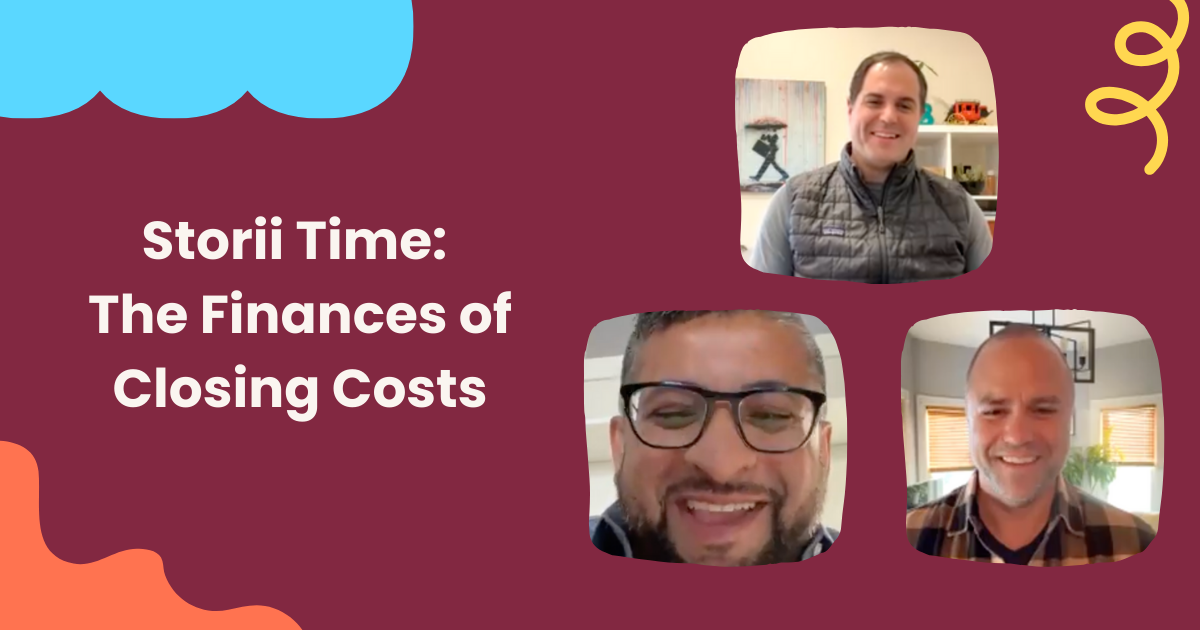
Our Storii Time hosts, Saad & Mike, welcomed Michael Vautour, M&T Bank lender, to chat about everything behind closing costs from the real cost breakdown to how it changes with different deals.
Saad: Too good. Well, Mike, thanks for joining us today.
Saad: Actually, so Mike S was the one that mentioned, he’s like, you we should do something talking about closing costs. It’s come up with a few deals recently, kind of like folks have questions, whether it’s earlier in the process or oftentimes a little bit later too, that there’ll be like kind of like shocked or surprised or what have you.
Saad: So I think one thing that would be helpful for folks listening today is like…what are some of the things that you think people should know about, especially on the financing side when it to closing costs and how do you turn it off?
Mike S: What are closing costs even to start that? Are you getting reverb a little bit or no? that just me?
Mike V: No, no, I’m not. can hear you guys.
Mike S: It seems like a little choppy. Anyway, let’s keep it rolling. If you guys, maybe it’s me.
Saad: It’s you.
Mike S: chop, chop, right, Mike. Yeah. What are closing costs?
Mike V: Yeah. mean, so closing fees are just costs that you have to pay to do transactions. So they come from typically four different areas. You have your bank fees because you have to pay the bank if you’re doing the loan. You have your attorney costs because it’s the state of Massachusetts. You need an attorney to close the transaction. And the attorney is going to have title insurance also in the fees. But we can kind of get that more in detail. The third area that fees come from are going to be the state of Massachusetts. So, those are your main three points//costs to do a loan. And then there’s something called prepaid items, which they’re technically not costs, but they’re money that you actually need for the transaction. So prepaid items, when I mean by that, is it’s called prepaid interest, property taxes and insurance. The prepaid interest, just simply put, the moment you start borrowing money, you gotta pay on it.
Mike V: Depending on the day you close, there’ll be prepaid interest just to take you to the end of the month. Then whether you have a loan or not, you have to pay for property taxes and homeowners’ insurance. Obviously, state of Mass or the city and town, they’re gonna charge you that. We have no dictation over what your property taxes are. And then your insurance, you get to shop and buy your own insurance policy.
Mike S: So, there’s no one to yell at for you you can’t Even though you’re not responsible for I assume that you get the price…
Mike V: Yeah, I mean I can give good advice I mean depending on what time you’re buying in sometimes they offer like a residential abatement residential tax exemption. I’m always trying to educate people on ways they can get their property taxes down, but aside from that that’s as that’s as much help as I can be
Mike S:I’d say that’s pretty good
Mike V:But yeah, mean, let me know what you want me to dig deeper on.
Saad: I think is one question I had. One thing I commonly tell folks when they ask me about closing costs is like how much they should estimate. And I oftentimes share with them…based on your purchase price, somewhere between one and a half and two percent. Sometimes it can be a little less. Is that accurate?
Mike V: Yeah. Absolutely. When I do an initial consult, I always ask clients, how much do you want to budget for this? What’s your cash outlay? And when they tell me that number, the next question I have is, does that include closing fees and prepaid items? Because that will kind of spark the next conversation. So they have a full understanding. Like, oh I have the 20 % or I have the 10 % and the 5%, but I wasn’t really thinking about the extra funds that are needed.
Mike V:You know, just like you, I hate surprises. Like I want, I want to be fully transparent with people just so, you know, there’s just no shock when they get to the closing table or there’s, you know, that they’re fully prepared so they can budget properly.
Mike V: I think that number, you know, 1.5 to 2 % is good. And it’s a sliding scale because the bigger the property that you buy, the more closing costs that will be, especially in the form of property taxes and insurance. So, I would say like, let’s just say someone’s buying a million dollar home. I would budget like 10 to 15,000 extra to have on top of your down payment in order to do that transaction.
Mike V: But there’s also variables to that. I mean, it depends if you’re buying a condo versus a single family versus a multi-family. So, sometimes, that can change the closing fees. Not the fees itself, but just the money that you need.
Mike S: Is that like a condo association or HOA fees? Like what else is there that would differentiate?
Mike V: Yeah, no, great point. So, let’s just say it’s like a new construction condo. Typically the association’s gonna require a two-month reserve that you pay at closing. And sometimes like even from the bank, like I don’t know that upfront. So, closing table, like let’s just say the condo dues are 500 bucks. Well, if you have to pay an extra thousand dollars of closing, that’s something that could come up. I always have to, you know, when I’m working with clients, if they are buying a condo, I just make sure that they’re aware that the HOA dues or condo dues are separate from the bank, but just to make sure that you have an understanding of what those costs are.
Mike V: I bring up multi-families because sometimes the insurance can be higher on those because sometimes if you’re buying a single family or a condo, your insurance might only be like $1,000 to $2,000 a year. Where if it’s a multi-family, those can run a little bit higher like in the $3,000 to $4,000 range. So there’s differences in that area.
Mike S: Are people typically like, who comes in knowing what like about closing costs? what percent, like is it like half the people or less?
Mike V: It’s people are pretty educated. I feel like a lot of people do research online before they even talk to me. Obviously, if someone’s bought a house in the past, they kind of have an understanding how it works. Still, if you’re not doing it on a daily basis, you kind of forget how things work. Even with the escrow account, we can kind of talk about that a little bit later too, after we answer any other questions we have on the closing fee specifically.
Saad:I think when it comes to when it comes to closing costs, I feel like the insurance fees, the taxes, the condo fees, those are things that are oftentimes lost and people forget that those are included. They understand lending fees, they understand that they pay their attorney fees, things like that. You mentioned condos, because of the condo fees, are closing costs typically higher for condos or not so much because the insurance cost is lower?
Mike V: It depends. the actual cost of the transactions are pretty much the same. Like we don’t charge the client higher fees because it’s condo versus a single family…and same thing with an attorney. Your fees for an attorney aren’t going to be different from a condo or single family.
Saad: Yeah, so I guess what I meant was mainly for the prepayments, right? Right, yeah. Those variables, that can be different, specifically for the HOA fees, but you’re right. On a condo, your insurance is going to be less because there’s a master insurance policy. So, your supplemental policy is typically cheaper. So, we see like, you know, a condo policy, like 600 bucks, a thousand bucks for the whole year. I think what people get tripped up on, and this is typically like the first question I get when clients review their final closing disclosure, is like, Hey, how come I have to pay for a whole year of insurance upfront? And then on top of that, you’re collecting money for the escrow account. Cause it looks like you’re paying like 14 to 15 months of insurance right away. And the reason being is because you have to pay the first year premium at closing for the insurance, your home is insured right away. And then your escrow account, and what an escrow account is for those that don’t know it, that’s an account that the bank manages for you that pay your future tax to insurance. So, the one year premium is paid right at closing, and then we collect two months of additional insurance so that way as you make your monthly payment throughout the year, you have enough money so then when next year’s insurance premiums due, you have enough money in that account to make that payment.
Mike S:I always like the, I got the email yesterday, it’s like we’ve paid your taxes for you. It’s like, oh, thank you, you, banks. I appreciate that.
Mike V: Absolutely, and the other thing that can get people caught up to are the prepaid items for taxes because we do our best to try to disclose like what we think the amount of taxes will be due at closing. But again, the city will determine what’s due. And if you’re closing and there’s a tax bill due within 60 days of close, they have to collect that as well. Sometimes you could be most towns in Massachusetts are paid quarterly. So there are circumstances where you have to pay up to six months of taxes at closing. And that can catch people off guard, too, because we’ll issue an initial loan estimate upfront. And sometimes that could show like three months of taxes and then when you get to closing like oh shoot you actually need six. Yeah. So it’s just kind of good to have that understanding going into it.
Saad: This is a bit of an aside from the conversation for the topic, but you mentioned escrow. Is there pros and cons to having escrows as part of your payment or not? For those who don’t know the concept, escrow when you get your loan you can escrow your taxes, you can escrow your insurance, so basically a bank is gonna be paying all of those for you so you don’t have to worry about it. My question for Mike, and for those who just recently joined, Mike Vautour , MNT Bank, one of our preferred lenders, he’s awesome. Mike S. and I have both done plenty of deals with him. So, I think it’d be helpful to hear a little bit about that. Are there pros and cons, or is it really like you wanna do it yourself or not?
Mike V: Yeah, absolutely. The pros of escrowing are convenience. You never have to think about it. The bank’s always gonna pay your insurance agent when the insurance bill becomes due. They’re always gonna pay your taxes, so you never have to think about it. From a cash flow standpoint, you’re paying things every single month as opposed to lump sums. So, you know, like I just had an insurance bill come due, and it was like $3,000 for my home, and it’s like, oh shoot, you know. And I chose not to escrow just because I…and I’ll get into some of the pros as to why, but it caught me off guard. I’m like, oh man, I was like, what is this coming to my account? So that’s a pro is from a cashflow standpoint, you’re paying everything on a monthly basis, you’re making a monthly payment, you kind of never have to think about it.
Mike V: The downside to escrowing is, unfortunately, property taxes insurance only go up. So your escrow account could have a shortage and the bank will reach out to you to say, you don’t have enough money in your escrow account, so now we have to collect extra money from you or your monthly payment will also go up as well. So, then that can kind of catch you off guard. Now, not escrowing, the benefit of that is you’re managing everything yourself. Your cash flow is better on a monthly basis because you’re only paying your mortgage, but then you just have to make sure that you’re remembering to pay your taxes on a quarterly basis, and then managing your own insurance on an annual basis.
Mike V: The disadvantage of not escrowing as well is some banks will charge to waive escrows. So, sometimes you actually have to pay money at closing to not have your taxes and insurance escrowed.
Saad: Is that bank to Yeah, it’s bank to bank. Fannie Mae, so any conventional loan, and when I say conventional loan, that means it conforms to Fannie Mae and Freddie Mac rules and regs, and that it’s sold to Fannie Mae in the secondary market. They charge a quarter of a point. to wave escrow. So just for ease of calculation, let’s say you’re borrowing a million dollars, you’ll get charged 2,500 bucks in order to pay your tax and insurance yourself.
Mike S: Interesting
Mike V: Yeah. I did not know that. Well, the banks make money on it too, because technically we’re housing those assets. Right. And while we do pay interest on those accounts, in Massachusetts it’s mandatory that we do pay interest. It’s a very, very small amount of interest.
Saad: I will say one of the worst pieces of mail you can get is that there’s a shortfall.
Mike S: I got the opposite. I got over budget.
Saad: Oh, that’s sure. That’s great. Yeah, that’s nice.
Mike S: Nice little reward at the end of the year.
Saad: But like you got it. I think to Mike’s point earlier, insurance costs are going up so much like everywhere. It’s like so rarely here of like the opposite of a shortfall. And actually taxes, they just, they only go up, right? So yeah, so I think it’s a really good point. It’s I think if you’re choosing to escrow, just know the important cause. Obviously, I think the convenience in my view, obviously everyone’s different. In my view, the convenience outweighs like the risk of a shortfall, because even if there is a shortfall, well, now you know, it’s just gonna automatically adjust your payment. But it’s important to know what those differences are. You have that option no matter what kind of loan you’re getting.
Saad: Now, if somebody’s paying cash, Mike, obviously I know you’re dealing with folks that are getting financing, right? But if somebody’s paying cash, they still have to pre-paids, right? Unless they’re not getting insurance. You don’t have to get insurance, I guess, if you’re paying cash.
Mike V:Yeah, I mean, you don’t have prepaid interest because you’re not borrowing money. But yeah, mean, technically you don’t need to get insurance, mean, that’s the risk. I mean, it would probably be in your best interest to have insurance on the property. Right. No one’s checking in if you do or not. So that’s up to you.
Saad: And then you don’t have the financing-related closing costs. So your closing costs naturally, if you’re paying cash, will be far less.
Mike V: Right. And when we break down the cost, I mean, the bank fees are, you know, sometimes the lowest fees. mean, like just for an M &T bank, for example, like we typically charge $1,250 to do alone like that’s a flat fee, no matter like what the loan size is, you have an appraisal fee because we have to make sure that the value of the home is there for the price you’re paying. That’s going to run between 680 bucks all the way up to 1500 bucks, depending on the value of the home. And then there’s a tax service fee for like $19 and then a flood certificate for like 50 bucks. So all in, I’m only like 2,000 to 2,500 for transaction. And then most of your fees are going to come from a real estate attorney in the form of title insurance.
Mike S: Let’s, yeah, let’s talk about that. And let’s talk about the two, the, the lender’s title insurance versus the homeowners. If you, if you could, my and enlighten us.
Mike V: Yeah. Yeah. So title insurance in general, in general, what that is, it protects your ownership interests in the home. So let’s just say you want to the property. If there’s something wrong with the title, like let’s say there’s a lien in the home or something like that and you can’t sell it because of that, your title insurance will cover you to protect your interest in the house. That’s kind of like what the overview is. And we can get more in detail of what that is in another call.
Mike V: But lender’s title insurance is mandatory. You have to get it. It’s a function of the loan amount that you borrow. And the reason why you have to get it is because if you stop paying your mortgage and we have to foreclose on your house, we need to make sure we’re able to then sell that house free and clear of any liens on the property. So that’s why it’s 100 % mandatory. I’m sorry, mandatory. Owners’ title insurance, that’s optional and that protects your ownership interest. So if you choose to waive it, which is completely your choice, let’s just say you go to sell it down the road and there’s an issue with title, then you’re in a really bad spot. But again, it makes no difference to us whether you take it or not, but I say it’s a one-time cost that you only pay when you buy the home. So, I would recommend it, but again, it is completely optional.
Mike S:That is a struggle with some clients sometimes and sometimes honestly, like I can’t give them a great reason beyond just the safety of that. Like if it’s like a newer home and it’s only had one owner or something like that. In fact, part of my like, you know what, let me look this up. It was actually started in the late 1800s when people would go away to war and then come back to their house to basically make sure that… because they were what, deeds on paper napkins back then and stuff. like, you never know who’s going to have claim to it. But over here, especially in like Massachusetts, where it’s, things have shifted so much and there’s been homes are 100 plus years old and have so many different owners, you never know what’s laying underneath the surface of that versus like a brand new construction, kind of like first time use.
Saad: I gotta say something about title insurance…you’re spending hundreds of thousands of dollars between what you’re putting down, your pump and payment, obviously your largest asset, what’s the $1,200 towards making sure that you don’t have to pay maybe $50,000 to avoid a title issue later on, right? Or to address a title issue later on. I feel like it’s, to Mike’s point, especially around…
Saad: By the way, welcome to our new listeners, Toha, Hailey, Anup, my wife, joined, she joined Lily. So Celine Duros, how you guys doing? Welcome.
Saad: My main point there was that, especially in Massachusetts, as Mike said, you have such older homes that there’s a long histories of ownership. Who cares if there’s been a gut reno or not or new construction or what have you. The land that those properties are on has moved to different owners over hundreds of years. You gotta be, I don’t know, I feel like it’s short money to get a lot of peace of mind.
Mike V: And at the end of the day, it comes from the real estate attorney that you work with. So I think that’d be a great segment for, know, Ali or some of your preferred attorney partners to maybe dive deeper into title insurance.
Mike V: It’s actually not just for older homes. We’ve seen even new construction where a builder won’t pay certain things and you have them lean on the property or some vendors will actually slap lean on the property and you never know about it. Then years and years go by and then you go to sell and now you can’t until that lien’s satisfied.
Mike S: Interesting. Do you have an example of that?
Mike V: Definitely happened before. yeah, without a doubt and then you know again, I’m not an attorney I’m not an attorney side, but I’ve seen transactions being held up because we’re waiting for the seller to cure a title issue. ah They mostly come from like older discharge loans too. So you’re right for like older…it was actually like craziness like just think back in 2009 when all the banks started failing…So you’d have all this paper being sold from one bank to the next and the next and the next and all of sudden, you couldn’t get a discharge because your original bank might have been like, you it could have been like some random bank, but now it’s owned 10 times later. So, to actually get a discharge to prove that you paid off a loan like 10 years ago was almost impossible. Huge title issues after like the bank, the housing crisis in 2010 through 2018. And luckily now we’re sort of well far past that, but that was one of the biggest issues we saw. Not to get on a weird tangent on title issue.
Mike S: no. Weird. We love weird tangents here on the story.
Saad: And frankly, it’s all part of closing costs, right? I think not enough people know about it as they approach home ownership. So it’s a helpful topic.
Saad: One thing I wanted to ask about too, Mike, was points. how do points like, are points part of closing costs? They part of prepayments? Yeah.
Mike V:So that’s a great question. So points are a premium that you pay for a lower rate, simply put. So let’s just take an example of a million dollar loan. One point is going to be 1 % of the loan amount. So 1 % of a million bucks is 10 grand. So you can pay $10,000 at closing to have a lower rate. And typically the way the math works out, is for every point that you pay, your rate is about a quarter to three eighths lower. So let’s just take a million dollar loan. Let’s just say today’s rate is 6%. So your monthly payment would be about $6,000 a month on a million dollars. And let’s say you’re like, well, I want my rate lower, and I want to pay that $10,000 upfront for the lower rate. Well, let’s say we can get you 5.625%. So that’s going to lower your payment to $5,788. So just for a quick example, so that saves you $211 a month by paying 10 grand upfront.
Mike V: I would only recommend points if you think you’re going to be in the property for a long time and have the loan for a long time. The reason being is because if you’re paying 10 grand to only save 200 bucks a month, that’s going to take you 50 months to break even. 4.1 year break even. So if you’re like, if you’re going to keep that loan for longer than that, great. That might be a good financial decision to do that. If you don’t know or you think you might refinance, it’s probably in your best interest not to pay points.
Mike S: Yeah. That versus like a two, one buy down. Have you seen a bunch of those over the last couple of years or…
Mike V: I’m not a fan of the two one by down.
Mike S: Yeah. Yeah. Tell me why..
Mike V: I’d rather have the money up front. Just give me the money. Cause why, why would I want to wait two years to get a savings? Because the way it works is a two one by down the seller has to pay it. And all they’re doing is paying the rate difference of 2 % for year one and 1 % for year two. Right. So let’s just say they’re crediting you 15 grand or 20 grand at closing that’s going towards that two one buy down. Well, you have to wait every single payment to actually make that money. Well, just give me the 20 grand right now. I’d rather just have that money immediately. Why should I wait to actually have my payments be reduced? Mentally, it might feel nice to have like a 4 % rate for year one and like a 5 % rate for year two, but just from a pure, I look at things mathematically give me the money now, could use that money towards something else, whether it’s investing or furniture, moving costs, things like that.
Saad: What about those situations where somebody like, honestly, could not even afford the home without the 2-1 buy down or 3-2?
Mike V: I mean…
Saad: Then should they just not be buying that?
Mike V: If they’re only qualifying because of a lower teaser rate, don’t buy that. Don’t do that.
Mike S: Yeah…
Saad: One other thing I want to ask Mike, I know we’re running low on time…So, different percentage down, like let’s say it’s the same property, different percentage down, different buyers, let’s say credit profile, income profile, asset profile, they’re like pretty similar. Does that make a difference in terms of closing costs? Do any of those other factors I mentioned make a difference in terms of closing costs?
Mike V: Sure. mean, so it makes a difference in like the rates you’re going to receive. Let’s just say someone with an 800 credit score, could get like a 6% rate. And if someone who has a 650 credit score, they might have a 7% rate. And the only way to get to 6% for them would be paying four points. So there would be additional costs just purely from a rate perspective. But as far as the credit score and down payment goes, it’s not going to change the fixed costs. The bank’s going to charge the same fee, whether you have a 600 credit score or 800 credit score. as far as like your pure flat fees and same thing with an attorney. It’s not like, you know, people are going to gouge you because you have a lower credit score. You’re right, that will 100% impact the rate that you receive, which in turn could impact your fees because you’d have to pay more of a premium to get the same rate as if you had an 800 credit score, if that makes sense.
Saad: Is closing costs dependent on the loan amount or the closing price?
Mike V: So the only things that are dependent on the loan amount are going to be the appraisal. or that’s more the value of the home. So let’s just say the host is worth two, $3 million. Well, your appraisal is probably gonna be closer to a thousand versus 600 bucks. Then, the owner’s title insurance and lender’s title insurance, that’s on a sliding scale based on the loan amount and the purchase price. So, those are really the only three variables that move other than your property taxes because a more expensive home, you have higher taxes.
Saad: Gotcha. Real quick, Mike, let’s chat about seller closing. So, the big difference and you know, either Mike, but the big difference is obviously sellers do not have financing closing costs, but they’ve got to pay like, you know, things like stamps, there’s a couple of this minor items. They still have to pay attorney fees, although attorneys tend to be little higher for seller, at least from what I’ve seen, the buyers and commissions.
Mike S: Yes. Right.
Saad: Did I missed any?
Mike V:The only thing that seller has to in Massachusetts is a state tax stamp. That differs by state. Obviously, if you’re in New Hampshire, it’s split. But just on Massachusetts, that’s one of the seller paid items that I could think of.
Saad: Right. And then, I think that the no financing naturally, you’re one selling it. And the commission, big kind of big takeaways, think, for anyone who’s interested in what seller’s code is supposed to be like. But because of the commissions, typically your closing cost as seller…I guess one question to you guys is, are commissions considered closing costs?
Mike V: It depends how it’s structured, but yes and no. I mean, if a buyer is technically paying the commission and it’s detailed out in their buyer’s contract and the seller isn’t paying it, technically that is a line item on the closing disclosure that they have to pay for that credits can be applied to it.
Mike V: It’s a little bit a gray area because if you actually dive into the lawsuit that basically dictated that sellers can no longer pay for buyer’s fees or can’t be baked into MLS, banks are technically not supposed to offer credits to pay for those, but it’s not really enforced.
Mike S: It’s the limitation of seller credits given to the buyer. say they’re covering points or doing with it. Is that is the commission included?
Mike V: No, that’s a great point. You’re right. we don’t consider it. Let’s just say the seller is paying a two and half percent fee for the buyer’s agent or the transaction costs, right? However we want to call it. We don’t come up that towards the seller paid limit. Depending on the down payment, a seller can credit up to nine percent. That’s if you have a twenty five percent or more down payment on the buyer side, but we don’t really see other than new construction. We’re not really seeing sellers give that large of a credit, but that’s a great.
Mike S:I was going to ask what in what situation would that like something even half that size come into play? only time we see him that high is when it’s new construction and the builder is trying to offer incentives to the property at a certain price.
Mike S: Okay. So, the reason being is that the seller or the builder wants to keep the sales price at a certain amount and then we’ll just….interesting yeah got you and obviously we’ve seen that plenty of times in past.
Saad: This was super helpful.
Mike S: yeah thanks man…so eloquent, I gotta say.
Mike V: 15 years of doing this, man. Anything you want to know, I know it.
Saad: Awesome well thank you so much thank you for those who joined I know Vince and Johnny joined recently so thanks for putting in guys. We’ll have Mike Vautour, M&T Bank. He’s awesome, one of our preferred partners. And we’ll see you guys next week on Storii Time, once again. Topic TBD.
Saad: He’s Mike. I’m Saad. He’s the other Mike.
Mike S: A couple of Mikes. Thanks for tuning in. Thanks, Mike.
Saad: Thanks, guys.
Mike V: Take care.
This Instagram live is transcribed for your easy reading. If you want to catch Storii Time live, every week, follow @saadmun1r and @photolowski on Instagram.